
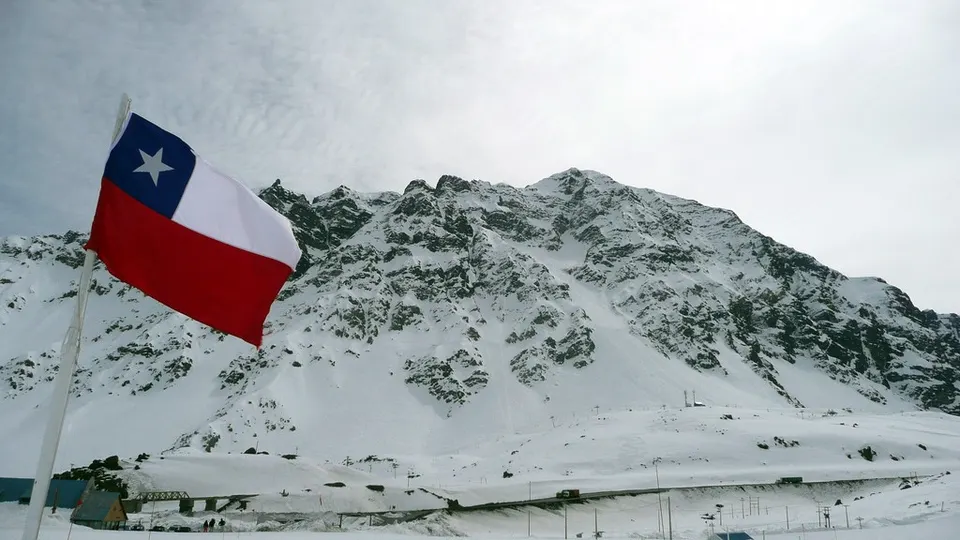
Portillo brings together a railway, a hotel and the 1966 World Championships; Arlberg, teaching and film; Hakuba, skiing and a hot spring network; Coronet Peak, tourism and a 1947 rope tow. Their histories offer four ways to look at a mountain trip.
A snow destination begins long before someone makes the first turn of their holiday. Visitors need to get there, find somewhere to stay, learn to ski and decide what to do afterwards. Sometimes a mountain’s identity lies in the answers a community found to those questions.
These four stories travel through Chile, Austria, Japan and New Zealand. They invite you to notice details a trail map cannot explain: a hotel, a school, a pipe or a rope can tell you as much about a place as its terrain.
Portillo: from the railway to the 1966 World Championships
Portillo’s published history recounts how, after the Trans-Andean Railway opened in 1910, skiers used the section between Caracoles and Juncal to gain elevation. The hotel opened in 1949 with 125 rooms; Bob Purcell and Dick Aldrich bought Portillo in 1961. Transport and accommodation gradually created a way to stay in the Andes as well as cross them.
The 1966 Alpine World Championships gave that process an international stage. Jean-Claude Killy won the men’s downhill there. The year 2026 marks sixty years since those championships: a historical anniversary, rather than an announcement of a celebration. Looking at the yellow hotel offers a chance to reflect on that relationship between hospitality and competition.
Arlberg: teaching helps build a destination
The Arlberg Ski School dates its official beginning to 1921. Its account highlights grouping students by ability and using trained instructors who followed shared guidelines. Hannes Schneider emerges as more than a talented skier: he helped organise a way of passing on knowledge.
That knowledge spread through several channels. Schneider and Arnold Lunn organised the Arlberg-Kandahar in 1928; Schneider travelled to Japan in 1930 to give lectures and seminars; Der weisse Rausch was filmed in Arlberg in 1931. Lessons, racing and film carried the mountain beyond its slopes. That heritage can enrich a visit to St. Anton without assuming today’s lessons repeat a century-old method.
Hakuba: hot water needs infrastructure too
After taking off your boots, an onsen can become another part of the trip. In Happo, that experience has a history of construction: hot spring wells one and two were successfully drilled in October 1983. In December 1986, another three kilometres of piping reached Happo and Daiichi Sato-no-Yu opened. The local timeline records another expansion of the water supply in November 1993.
Hakuba was also one of the communities that hosted events at Nagano 1998. That combination of mountains, sport and bathing helps explain the destination beyond a snowfall figure. To visit a particular establishment, check its hours and entry rules, including tattoos and clothing; policies differ between facilities.
Coronet Peak: a rope changed the climb
Te Ara, the encyclopedia of New Zealand’s Ministry for Culture and Heritage, identifies Coronet Peak as the country’s first commercial skifield, opened in 1947. A rope tow designed by Bill Hamilton, also known for his work on the jet boat, was installed that year. The innovation addressed a specific need: getting back uphill for another run.
The rope was neither the world’s first ski lift nor the beginning of all skiing in New Zealand. Its significance lies in showing how an access solution can turn a slope into a commercial destination. When exploring the Queenstown region, that question remains useful: how do the mountain, transport and accommodation fit the trip you want to make?
Bring history into your next comparison
To turn curiosity into a trip, start with the Portillo, St. Anton, Hakuba Happo-One and Coronet Peak destination pages linked below. Compare the season, terrain level and transfers, then check the operator for daily operations. History explains a mountain’s character; your itinerary also needs practical information for your chosen dates.
Frequently asked questions
Was Portillo 1966 an edition of the Olympic Games?
No. Portillo hosted the 1966 Alpine World Championships. World Championships, Olympic Games and the World Cup are different competitions.
Does Hakuba’s hot spring history establish a medical benefit?
No. This article describes the development of the hot spring network. It makes no medical claims about the water and does not generalise the rules of its baths.
Sources and editorial approach
This guide draws on the linked sources. We distinguish historical facts, announced dates and conditions that need a current check. Confirm operations, access and services with the destination operator before booking.
- Ski Portillo: our history
- FIS: Portillo 1966 downhill result
- Arlberg Ski School: history since 1921
- U.S. Ski & Snowboard Hall of Fame: Hannes Schneider
- Ski Arlberg: skiing and film history
- Hakuba Happo Onsen: history of the hot spring network
- Japanese Olympic Committee: Nagano 1998
- Te Ara: commercial skifields
- Te Ara: the Coronet Peak rope tow